
Large-scale solar park project by EPV Aurinkovoima Oy
Large-scale solar park project by EPV Aurinkovoima Oy
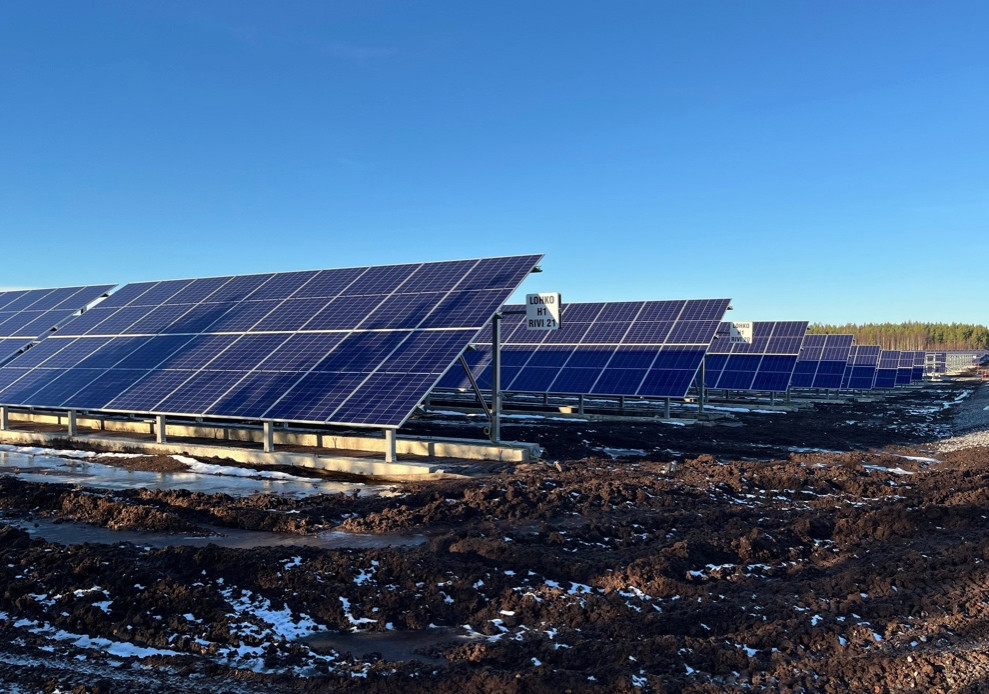
EPV Aurinkovoima Oy’s solar park project in Heinineva in Lapua, Finland began with permit applications in early 2020. The industrial-scale park, which features around 140,000 solar panels, will be fully operational by the end of 2025. Menna Luhtala, the Regional Development Manager at EPV Aurinkovoima Oy responsible for permits and environmental issues, and Mats Lärka, the Team Leader for Infrastructure Works, talk about this challenging project and their cooperation with Maveplan.
Heinineva Solar Park:
- Total capacity: ca 100 MWp
- Approx. 140,000 solar panels
- Single panel output: ca 700 Wp
- Average annual power production during life cycle of park: over 90 GWh
- Total length of panel rails: ca 100 km
- Total area: 140 ha
Heinineva was a 1+1 project for Maveplan: we have decades of experience in the area, plus knowledge of peatland requirements.
Juha Laakso, Maveplan Oy
A demanding area for green commercial use
The ground in Heinineva presents a challenge for the construction of roads and solar panel rack foundations. ”There was no bearing ground, and the open field ditches ran in the wrong direction for the racks,” Lärka explained. “The drainage at least was the right solution from that point of view.” Maveplan’s plan combined new controlled drains with existing water treatment structures originating from peat production. “There is now a controlled drainage system in the area, where the water flows through control wells to sediment basins, from where it is pumped to the vegetation field freed up from peat production,” Luhtala said. “As such, all the water exits through one point, and we can monitor its quality. Taking this approach, we’ve taken the best existing aspects and applied them to our new solution.” Benefits of controlled drainage:- The levelling of the field facilitates the construction phase and the laying of foundations
- Soil acidity control
- Climate emissions control: acid sulphate soil oxidation and emissions can be prevented using drainage control wells, and raising the water level also prevents carbon dioxide emissions from peat decomposition
- Controlled temporary lowering of the water level, e.g. for maintenance
- Vegetation management using water level regulation: deep-rooted plants will not take root below the water level
- All water from the site is discharged through a single point, with the water’s quality being monitored and water being pumped into the vegetation field
- Regional water management: 18 control wells in 11 blocks of the solar park for regional water management
Maveplan team leader Juha Laakso sums up the starting points and solutions at the Heinineva site
Juha Laakso has decades of experience of peat mines and arable land in South Ostrobothnia, where the conditions in Heinineva were known to him as much as 20 years ago. His own job description includes preparing drainage and soil extraction plans and dealing with environmental permit issues. Starting points:- The area of South Ostrobothnia contains acidic subsoil from the ancient Litorina Sea.
- The Heinineva project was one of the first solar parks built on an acid sulphate peat bog in Finland, meaning it was something new for authorities as well.
- EPV and Maveplan devised the modus operandi for the implementation of peatland solar parks.
- The drainage and water and acidity management solution was driven by factors such as ground relief and peat layer thickness. Heinineva has a predominantly thick peat layer.
- Heinineva had field ditches every 20 metres, which previously acted as a solution for the improvement of the soil’s bearing capacity and water management in the energy peat bog.
- The field ditches were transverse to the panel rows, so the terrain had to be levelled and the ditches filled.
- Controlled drainage was chosen because it can control the amount and acidity of drainage water in the area and reduce greenhouse gas emissions from soil decomposition.
- It was possible to design the drainage in unobstructed soil because the solar panels were not anchored to the ground with piles, but with pressure plates tested by EPV.
- The locations of the controlled drains were mainly marked on the terrain using automated machine control based on the national ETRS TM-35 coordinate system.
- To control the water, the controlled drains were put into use with as little water as possible.
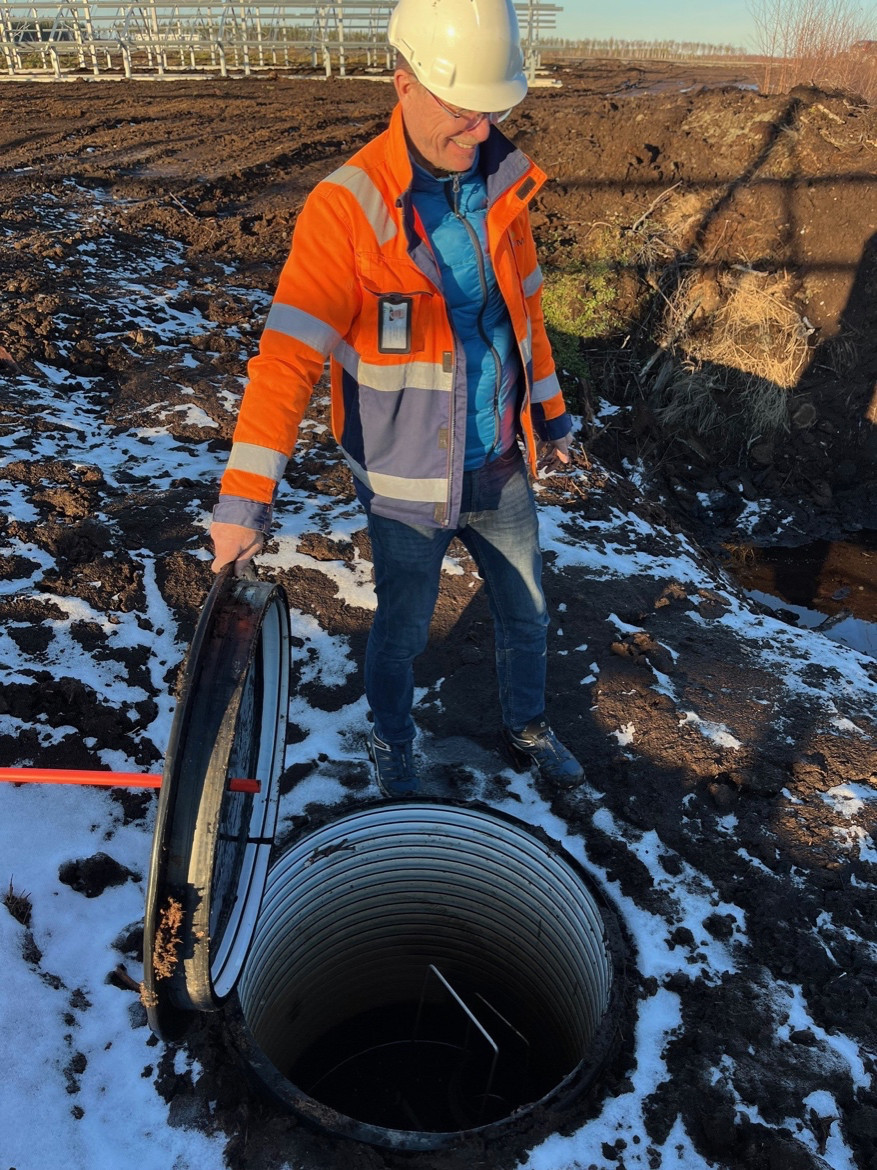
Juha Laakso from Maveplan at a drain control well.
To be continued…
The use of peatland for solar parks requires good planning, as the soil beneath the peat determines implementation on a case-by-case basis. “In Heinineva, only one foundation method was used, but the drainage style and foundation vary from case to case,” Lärka explained. “On some sites we might use two or three foundation methods. For the future, we have learned that drainage plans need to be made in advance to allow for the regulatory phase of the permit process. As such, drainage must continue to be done all at once. It can’t be done retrospectively, as this would delay the completion of the project.” Luhtala adds that this is linked to possible future subsidies, which could be lost if the project does not keep to schedule. EPV Energia Oy and its subsidiary EPV Aurinkovoima Oy are pioneers in emission-free energy production. Solar energy complements their product portfolio. A dedicated solar energy measurement station is being used to study and improve the predictability of solar power. Decentralised energy production is also better in supporting energy security. Heinineva is the first solar power project of EPV Aurinkovoima Oy, which also created an operating model for the construction of a solar park. The establishment of the park in a marshy area, and the size of the project, set high standards. The lessons learned can be applied to similar, less demanding projects. The company’s next solar power project is already in the pipeline. ”Each project is different, but the core concept has now been established,” said Lärka. “There’s always room for improvement when creating the first one, but all in all, the process has gone smoothly at Heinineva, and the boundaries between partners were clear. Responsibilities were taken over by one partner from the other, such as Maveplan’s designs being taken to their partner’s more detailed level, for instance where the electrical engineering was concerned. And in addition to learning, there’s also been development. Finnish-made energy collectors are being tested at Heinineva.” Luhtala adds that they are employing local companies and continuing to work with partners like Maveplan, who they wholeheartedly recommend. The Heinineva Solar Park project was granted NextGenerationEU funding of 12 million euros from the EU Recovery and Restoration Fund (RRF) on 8 December 2022. The total value of the project as noted in the application was 64.5 million euros.
EPV Aurinkovoima Oy
100% subsidiary of EPV Energia Oy
Established in 2022
Heinineva Solar Park is the company’s first solar energy project
www.epvaurinkovoima.fi
www.epv.fi
Images:
Main image: Heinineva 11/2024, EPV Aurinkovoima Oy
Article images: Maveplan Oy